RC excavators: hydraulic or mechanical, and how many channels?
What actually separates a hydraulic machine from a mechanical one, how many channels you need before adding attachments, and what ownership really involves.
Written by rcgadmin
RC excavators: hydraulic or mechanical, and how many channels?
RC construction is a quieter corner of the hobby than racing, and a more absorbing one. Nothing else in RC rewards patience the way loading a dump truck with a hydraulic excavator does. If you are looking at your first machine, the choice comes down to how the functions are driven.
Mechanical versus hydraulic
Mechanical models move the boom, arm and bucket with small motors driving lead screws or gears. They are cheaper, simpler and far more robust. Movement is a little more abrupt than the real thing, and holding a load steady is less convincing — but nothing leaks, and there is very little to service.
Hydraulic models use a pump, valves and real cylinders filled with oil. Movement is smooth and proportional in a way mechanical drive cannot match, and the machine behaves like the real one: it slows under load, holds position, and settles. That realism is the entire reason hydraulics exist.
The cost is money and maintenance. Hydraulic machines are substantially more expensive, need occasional bleeding, and will eventually seep oil from a fitting. That is normal ownership, not a fault — but it is ownership, not just operation.
Channels, and why the count matters
Each independent function needs a channel. A basic excavator needs slew, boom, arm, bucket and two tracks — six functions before you add anything. Machines are commonly sold as 8, 12 or 15 channel.
- 8 channel covers the core functions well.
- 12 channel adds working lights, sound, and usually a quick-change coupler.
- 15 channel and above supports attachments — breaker, grab, shear — plus auxiliary hydraulics.
If you expect to run attachments, buy the channels up front. Adding them later is not a simple upgrade.
Metal, and how much of it
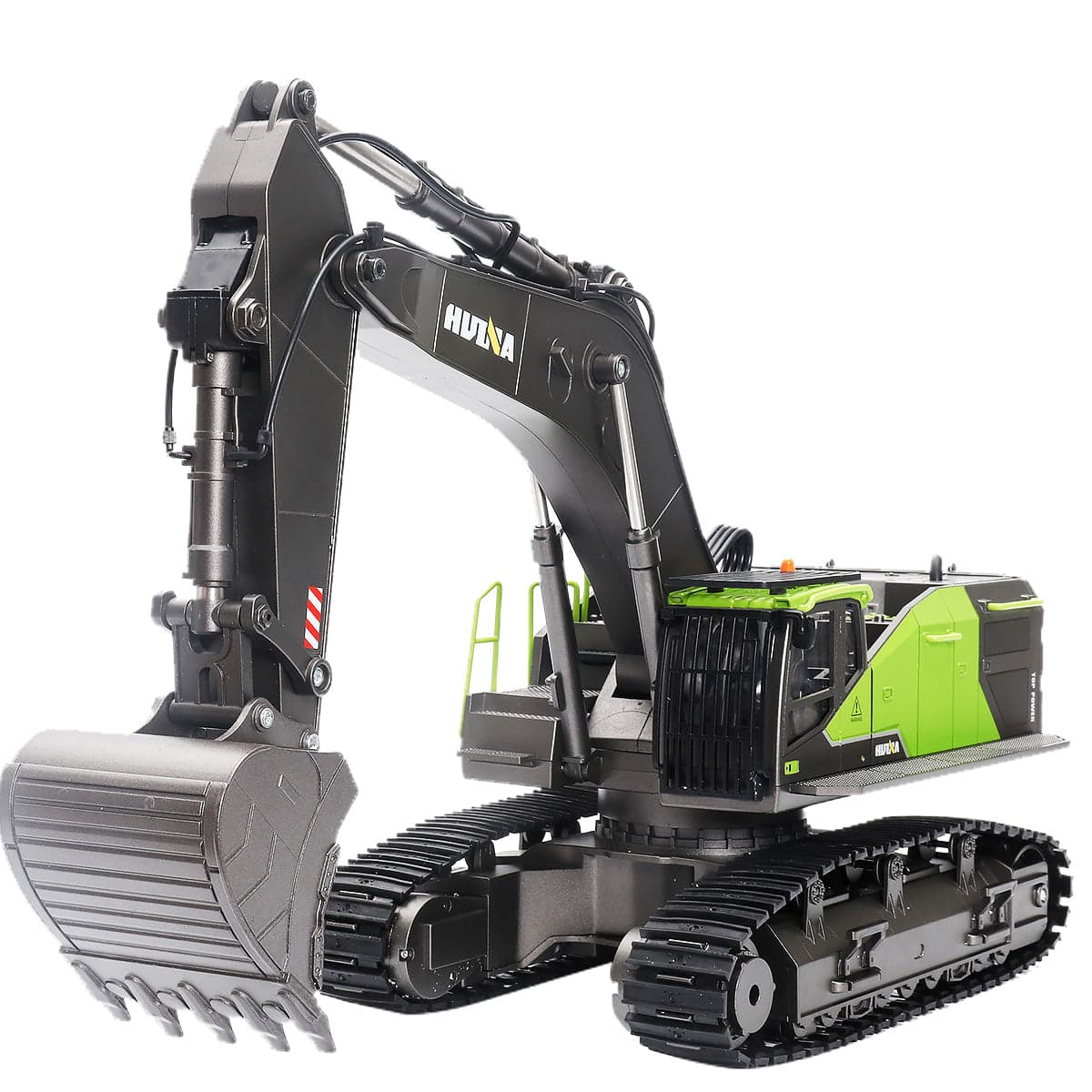
"All metal" is used loosely. Read it carefully: some machines have a metal boom and arm on a plastic chassis, others are metal throughout including the tracks and slew ring.
Metal tracks look and sound right, and they last. They also add weight, which is mostly good — a heavier machine is more stable digging — and they are noisier on hard surfaces. Where a listing does not make the extent of the metalwork clear, ask before assuming.
Scale
1:14 is the working standard: large enough for genuine hydraulics and fine detail, small enough to run in a garden or on a dirt pile. 1:12 appears on some larger machines. 1:50 is display scale — diecast, static or lightly functional, made for a shelf rather than a sandpit.
Where to run it
A dirt pile, a sand tray, or a corner of the garden turned over to it. Fine dry sand is kinder to bearings than wet clay, which finds its way into everything and sets. Whatever the surface, brush the machine down afterwards and keep grit away from the slew ring.
Ownership, honestly
- Check the tracks for trapped stones after every session.
- Keep the slew ring clean — grit there is the most common cause of rough rotation.
- On hydraulics, expect to bleed the system occasionally and to see a little seepage at fittings.
- Store it indoors. Metal, damp and cold is a bad combination.
- Do not force a stalled function. If the boom stops, something is jammed — find it rather than holding the stick.
Buy mechanical if you want to dig this weekend without thinking about it. Buy hydraulic if the way the machine moves is the point — and it genuinely is, for most people who end up staying with construction models.